In Indian numerology, your date of birth gives you two core numbers: the Mulank and the Bhagyank. People often mix them up, or assume they are the same thing, but they are calculated differently and describe different sides of you. Almost every other numerology check, from name correction to choosing a mobile number, starts by comparing with these two.
Mulank: the number of the day
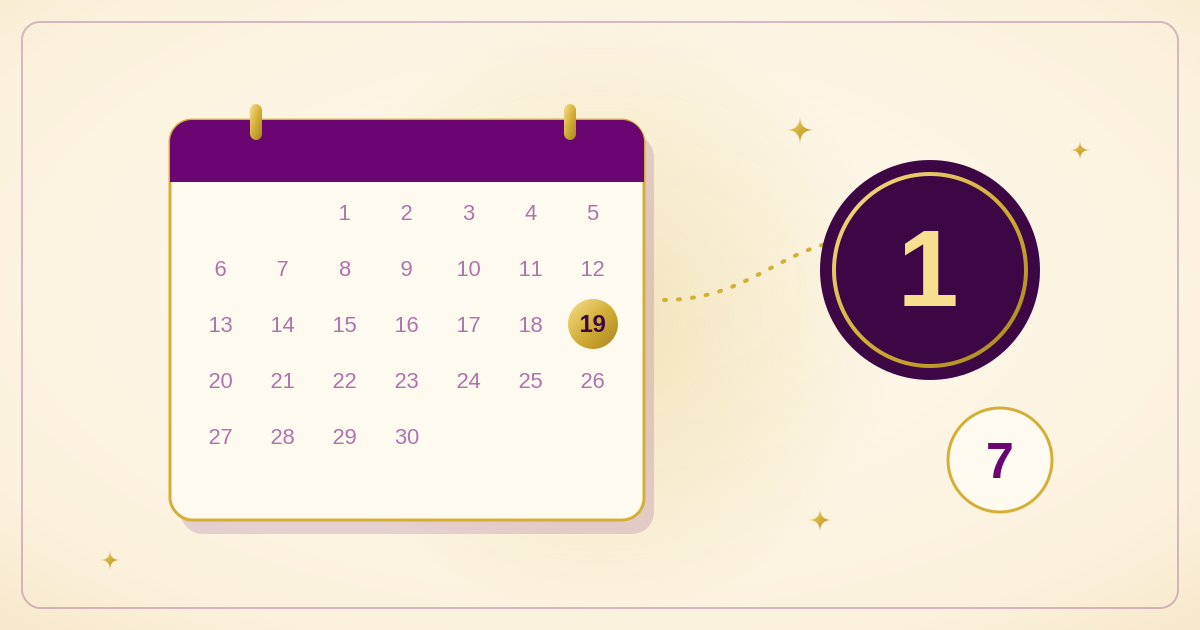
Mulank means 'root number'. It uses only the day of the month you were born, reduced to a single digit. Born on the 4th: Mulank 4. Born on the 19th: 1 + 9 = 10, and 1 + 0 = 1, so Mulank 1. Born on the 30th: 3 + 0 = 3.
Because it comes from the day alone, everyone born on the 1st, 10th, 19th or 28th of any month shares Mulank 1. It is also called the psychic number or birth number, and in English-language numerology it is close to what is called the day number.
Bhagyank: the number of the whole date
Bhagyank means 'destiny number'. It adds every digit of your full date of birth, day, month and year, and reduces the total to one digit. For 19-08-1996: 1 + 9 + 0 + 8 + 1 + 9 + 9 + 6 = 43, and 4 + 3 = 7. So this person has Mulank 1 and Bhagyank 7.
You can also reduce the day, month and year separately first: 19 gives 1, 08 gives 8, 1996 gives 25 and then 7; and 1 + 8 + 7 = 16, which gives 7. Both methods always reach the same single digit, because reducing a number by adding its digits never changes its remainder when divided by 9. In Western numerology the same figure is usually called the Life Path number, though some Western schools keep 11, 22 and 33 unreduced as 'master numbers'; Indian numerology normally reduces all the way to 1 to 9.
What each one describes
The Mulank is about who you are day to day: your natural temperament, how you react, what you enjoy and how others see you at first. It is usually felt most strongly in the first half of life. Our profile of each Mulank goes through all nine.
The Bhagyank is about where life tends to take you: your broader purpose, the lessons that keep coming back and the kind of results your efforts produce over time. Many numerologists say its influence grows stronger with age, especially after the mid-thirties.
One way to picture it: the Mulank is the vehicle, the Bhagyank is the road. A Mulank 1 with Bhagyank 7, as in our example, may be bold and self-starting by nature, yet find that life keeps pulling them towards study, reflection and depth.
When the two agree, and when they don't
When the planets of the two numbers are friends, for example Mulank 3 (Jupiter) with Bhagyank 9 (Mars), nature and direction pull together and life tends to feel more straightforward. When they are enemies, for example Mulank 1 (Sun) with Bhagyank 8 (Saturn), people often describe an inner tug-of-war: wanting quick recognition while life insists on slow, patient work.
A clash is not bad luck. It simply shows where effort is needed, and many accomplished people have exactly this kind of tension in their numbers.
How they are used together
Name number: in name correction, the Chaldean name number should be friendly to both, or at least not hostile to either. If it clashes with one, numerologists look for a spelling that suits both. Dates and numbers: for important dates, mobile numbers or vehicle numbers, the Bhagyank is usually given the main weight for long-term matters and the Mulank for everyday ones. Lo Shu grid: the digits of the full date, not just the two totals, are placed on a 3 × 3 grid to show which numbers are strong and which are missing.
Common mistakes
Using only the year or only the month: the Mulank needs the day alone, and the Bhagyank needs every digit. Using the wrong calendar date: if you were born just after midnight, numerology uses the calendar date, not the Hindu day that runs from sunrise. Mixing up the name: the name number uses the name you actually use, not necessarily the one on your birth certificate.
Our free Mulank Calculator shows both numbers at once, and you can check your name free to see whether it suits them. For a fuller picture of your direction in life, the Life Path reading builds on your Bhagyank.