Few words cause as much anxiety in Indian matchmaking as "Manglik". A family hears that the boy or the girl is Manglik and the conversation often stops there. Yet Manglik dosha, also called Mangal dosha, or Kuja dosha in the South, is one of the most common features of a horoscope, and classical astrology itself lists many situations in which it is reduced or cancelled.
This guide explains what the dosha actually is, why so many people have it, how it is cancelled and how a careful astrologer weighs it when matching two charts.
What makes a chart Manglik
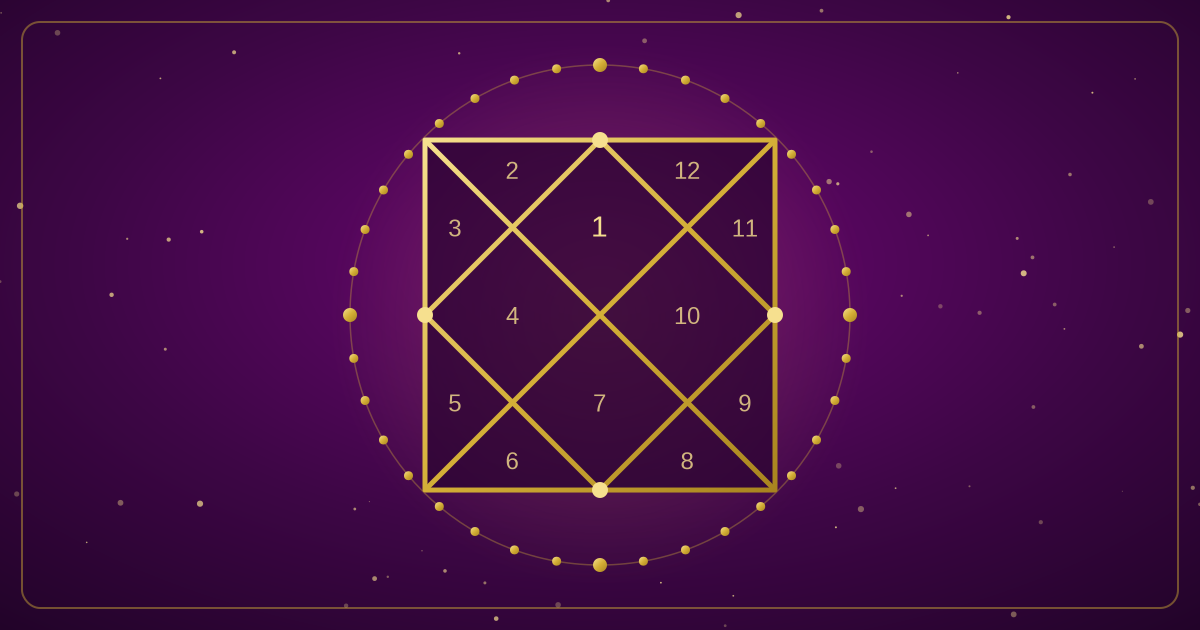
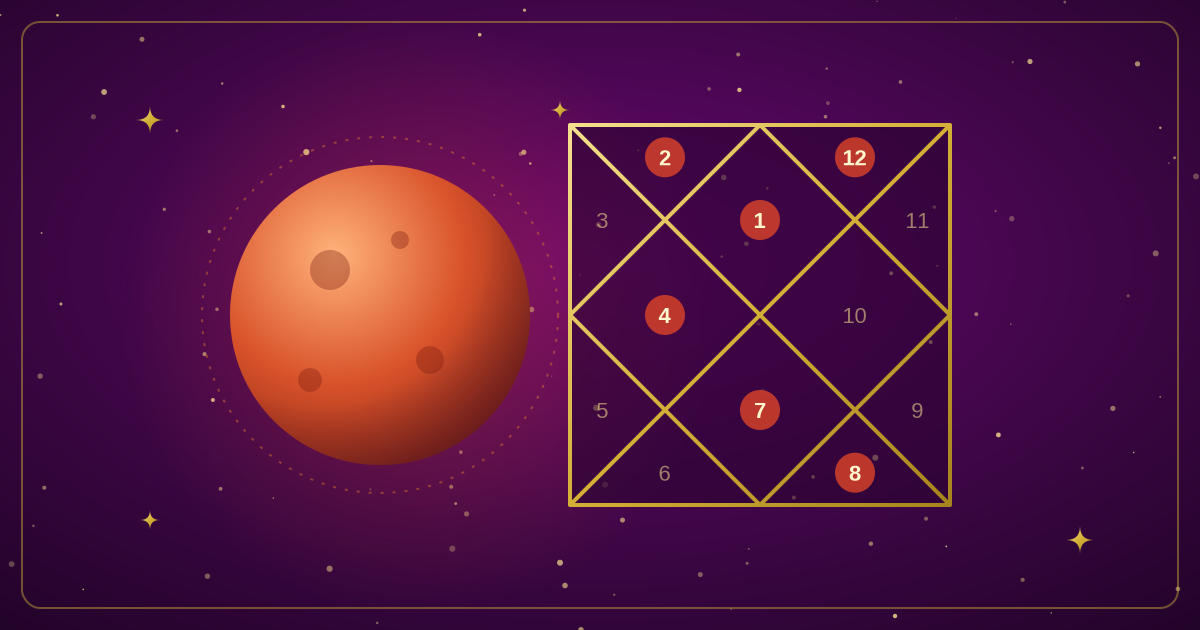
A chart is called Manglik when Mars (Mangal) sits in the 1st, 2nd, 4th, 7th, 8th or 12th house. Some traditions, mostly in North India, leave out the 2nd house and use only five houses; South Indian astrologers usually include it. The houses are counted first from the ascendant (lagna), and many astrologers also check them from the Moon and from Venus, because those points also describe the mind and relationships.
The reasoning is that Mars is the planet of energy, drive and heat. In houses connected with the self (1st), family and speech (2nd), home and peace of mind (4th), the partner (7th), shared resources and sudden events (8th) and the bed and expenses (12th), that energy can show up as impatience, arguments or friction in married life when it is not channelled well.
Why so many people are Manglik
Six houses out of twelve means that, counted from the lagna alone, roughly half of all charts have Mars in one of them. Add the checks from the Moon and from Venus and the share rises further. Something that applies to half of the population cannot be a sign of disaster, and thoughtful astrologers treat it as a tendency to understand rather than a verdict.
This is also why the strength of the dosha matters more than its presence. Mars in the 7th or 8th house is traditionally treated as stronger than Mars in the 2nd or 12th, and a dosha found only from Venus is weaker than one found from the lagna, the Moon and Venus together. Many reports describe a mild case as "anshik", or partial, Manglik.
Classical cancellations
Texts and regional traditions list several conditions under which the dosha is considered reduced or cancelled. The lists differ from one source to another, but the most commonly cited ones are these.
Mars in its own sign (Aries or Scorpio) or exalted in Capricorn, where it is dignified and better behaved. Jupiter conjoining or aspecting Mars, or a strong Jupiter in the 1st or 7th house, which is said to soften it. Particular sign and house combinations, for example Mars in the 2nd house in Gemini or Virgo, in the 4th in Aries or Scorpio, in the 7th in Capricorn or Cancer, in the 8th in Sagittarius or Pisces, and in the 12th in Taurus or Libra. Several authorities also treat Mars in Leo or Aquarius as a cancellation.
Because the lists vary, two astrologers can reach slightly different conclusions for the same chart. A good report names the rule it applied rather than simply saying yes or no.
Manglik matching between partners
The best-known rule is that when both partners are Manglik, the dosha is considered matched and is no longer an obstacle. Many astrologers also accept a match where the other partner has Saturn, Rahu or Ketu in one of the same houses, since these planets are thought to balance the effect of Mars.
When only one partner is Manglik, the astrologer looks at how strong the dosha is, whether a cancellation applies and how the rest of the match looks: the Guna Milan score, Nadi and Bhakoot, the 7th house and Venus in both charts, and the Navamsa. A mild dosha in an otherwise strong match is a very different thing from a strong dosha in a weak one.
The age-28 belief
You will often hear that Manglik dosha ends at 28, because Mars is said to mature at that age. This is a popular belief rather than a firm classical rule, and astrologers disagree about it. It is fair to say that temperament settles with age, but it is better to look at the actual chart than to rely on a birthday.
Remedies, without fear
Traditional remedies are simple: reciting the Hanuman Chalisa or the Mangal mantra, especially on Tuesdays; fasting on Tuesdays if your health allows; donating red lentils (masoor dal) or jaggery; and putting Mars energy into sport, exercise or disciplined work. Some families perform Kumbh Vivah or a similar ritual before the wedding. That is a matter of tradition and personal faith, and no one should be pressured into it.
Be wary of anyone who says a Manglik person cannot marry, that a marriage is bound to fail, or who asks for large sums for special pujas. Astrology describes tendencies; it does not decide outcomes. Communication, respect and patience do far more for a marriage than any single planet.
How to check your own chart
You need an accurate date, time and place of birth, because the ascendant changes roughly every two hours and that decides which house Mars falls in. Our Manglik Check tells you whether Mars forms the dosha in your chart, how strong it is and which cancellations apply. For a couple, the Kundli Milan Report compares the Manglik status of both partners alongside the full 36-point match.